Agent Identification
Trace every action back to the agent that took it
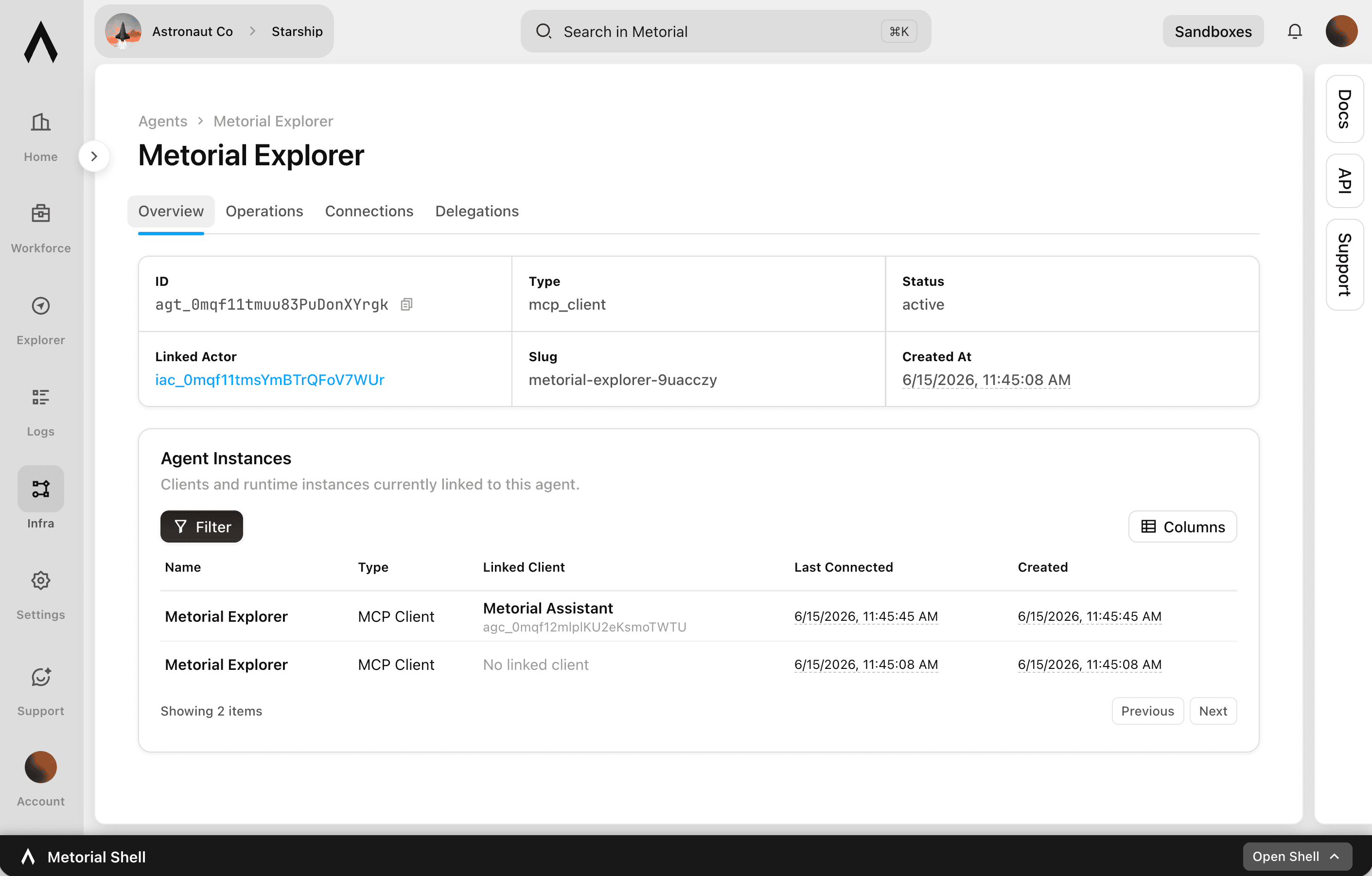
When several agents act across your systems, "an agent did it" isn't an answer. Metorial gives each agent a distinct identity. Every tool call, error, and log ties back to the specific agent that produced it and the user running it, and you can see precisely who did what at any point.
- 01
Trace every action to a specific agent.
Tool calls, errors, and logs are tied to the agent that produced them, down to the user and the workstation it ran on. Nothing happens anonymously.
- 02
Keep agents inside their user's permissions.
Each agent is authenticated and authorized against the policies of the person running it, and a sub-agent can never do more than its parent.
- 03
Control and revoke access per agent.
Grant or block specific tools and actions for one agent and one session, and cut off access instantly if an agent is compromised or misbehaving.
Why identity matters
What you can do once every agent is identified
Agent identity is the foundation other Metorial controls build on. Once each agent is distinct, governance and visibility become precise instead of broad.
Tie actions to an owner
Grant access deliberately
Enforce per-agent rules
How agent identity works
Identity applied to every agent and every action
- Agents with a unique identityEvery
- Actions traceable to an agent100%
- Access an agent has by defaultNone
- Access scoped per agent and sessionYes
Give every agent an identity. Trace every action to its owner. Keep agents inside their user's permissions. Revoke access the moment you need to.
FAQ
Answers to common questions about agent identification and how they fit into governed AI agent infrastructure.
What is agent identification?
Agent identification gives each AI agent a unique identity in Metorial. That identity is attached to everything the agent does. Actions, errors, and logs can be traced back to a specific agent and the user running it.Can I tell which agent and user performed an action?
Yes. Every tool call and message is tied to the agent that made it, the user behind it, and the client it ran on. You can attribute activity precisely in audit logs and tracing.Can an agent do more than the user running it?
No. Each agent is authenticated and authorized against the policies of its user, and a sub-agent can never exceed its parent agent. Agents start with no access, and every permission is granted explicitly.Can I restrict access for a single agent?
Yes. Because agents are identified separately, you can allow or block specific tools and actions for one agent and one session through policies and access control, without affecting other agents.What happens if an agent is compromised or misbehaving?
You can revoke its access instantly. Since access is tied to the agent's identity, cutting it off stops that agent without disrupting other agents or users.How does agent identification relate to delegation?
Identity is the foundation for identity and delegation. When a user grants an agent access to a tool, that grant is tied to the agent's identity, logged, and revocable at any time.