Metorial vs Arcade.dev: Full Comparison (2026)
Arcade.dev and Metorial agree on the hard part: agents act as the real signed-in user, credentials never reach the model, and every action is logged against a real identity. Both ship SDKs, both hold SOC 2, both can be deployed on-prem. The difference is what sits above that floor. Arcade is a developer tool. Every agent needs code wired in, and there's no interface for anyone outside engineering. Metorial covers the same ground and adds a collaborative interface where non-engineers build and share skills themselves, plus hosting for your own custom MCP servers.
If you're evaluating gateways for AI agents right now, Arcade.dev and Metorial probably showed up on the same shortlist. Both connect agents to the tools your company already uses. Both talk about security and access control. And both are easy to mix up from the homepage alone. The two products are built for different people, and which one fits depends on who in your company is blocked right now.
Both are what's generally called an AI agent gateway, or runtime: infrastructure that sits between an agent and the outside systems it needs to touch, so a request like "refund this customer" turns into an authenticated, logged call to a system like Stripe instead of a raw API key sitting in someone's config files. Both also build on MCP, the protocol that lets an AI model call external tools in the first place. The question this post answers is which one to put in that position, and why.
What to actually check
Before comparing features, it helps to be specific about what to check, because a feature list from either homepage won't tell you this on its own.
Setup time. Can your team have it running this week, or does it need one of the vendor's own engineers involved first? A rollout that depends on someone else's calendar is a rollout that slips a quarter.
Who can use it. Once it's running, can anyone outside engineering configure or extend it, or does every change go through a developer? That's the difference between a tool your ops or support lead can use directly and one where they file a request and wait.
Deployment options. Is there a real path to running it on your own infrastructure? Both products have one, and they differ in shape: Arcade names more configurations, Metorial is open source, so your security team can read what they're running.
Access control. When an agent takes an action, does the system know it was a specific person acting within their existing permissions, or does it look like an anonymous service account did it?
Cost model. Do you pay a flat fee, pay per use, or run it yourself for free? Usage-based pricing is fine until it's tied to volume you don't control.
The rest of this post compares Arcade.dev and Metorial on these five, then says plainly which one fits which rollout.
What Arcade.dev is built to do
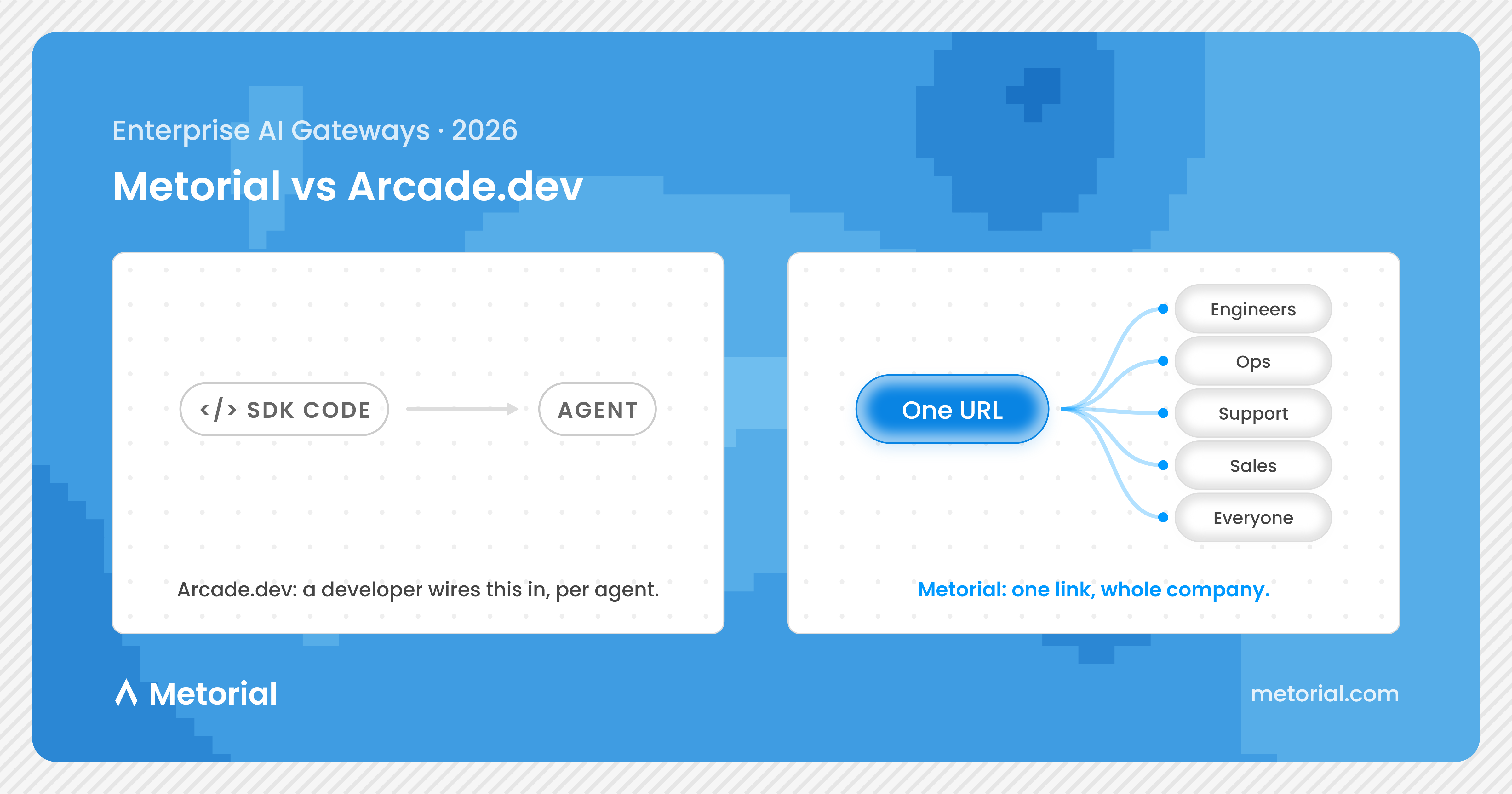
Arcade is a runtime a developer wires directly into an agent's own code, using Arcade's SDK, a code library added to that application. It handles the OAuth login flow (the same standard behind "Sign in with Google" buttons) and token lifecycle for each external service, so an agent acts as the specific person who's logged in rather than through one shared password. Every action gets recorded: which agent did it, on whose behalf, and in which system.
The team's credibility here is genuine. Its founders and engineers came from Okta, Snowflake, Redis, Airbyte, and MongoDB; they authored part of the MCP tool authorization specification and sit on the steering committees for MCP security and governance.
It deploys to your own cloud, a virtual private cloud, on-premises, or a fully air-gapped environment, and it holds SOC 2 with SSO, role-based permissions, and audit logs included. It works with most agent frameworks (LangChain, LlamaIndex, Mastra, CrewAI, Pydantic, Google's ADK, OpenAI's Agents SDK) and any client that speaks MCP, including Claude, Cursor, ChatGPT, and Copilot. Per Arcade's site, LangChain, Snyk, Relevance AI, and Sybill are users.
Here's where it stops. Arcade is a tool for developers: its own documentation is explicit that using it means writing code, and there's no interface for someone outside engineering to set up or edit a tool. It has no dedicated feature for trimming which tools get loaded into a request to cut token cost. And nothing in Arcade's public materials describes detecting MCP servers already running inside a company without central approval, sometimes called shadow MCP.
What Metorial is built to do
Metorial starts from a different question. Instead of only asking a developer to wire code into every agent, it gives each employee one link, which Metorial calls Magic MCP, that works the same way inside whatever client they already use: Claude, Cursor, or Codex.
That same idea extends past connecting tools and into building them. One person in a team can write a workflow once, in a shared editor, and it appears for every teammate who's supposed to have it, including people who don't write code or hold a GitHub account. That's the piece Arcade doesn't have: a way for a support lead or an ops manager to build something themselves instead of filing a request with engineering.
Developers get the same depth they'd expect from a runtime. Official SDKs for TypeScript, Python, and Go, with adapters for OpenAI, Anthropic, AI SDK, PydanticAI, LangChain, and LangGraph. A CLI for integration work in the terminal, in scripts, and in CI. And a platform where everything in the dashboard is also available through the API: integrations, access control, policies, identities, skills, and Magic MCP itself.
None of that comes without the access controls a security team will ask about. Employees sign in with the same company login already used for email, and their permissions follow their existing role. Secrets sit in Metorial Vault, encrypted with KMS and resolved at the gateway, so they never reach the model or the client. Every tool call runs through a layer that screens for prompt injection, watches for provider schema changes, and blocks anything outside policy, then gets logged for later review. The platform is open source and self-hostable. It holds SOC 2 Type II certification and complies with GDPR.
Here's where it stops. There's no dedicated token-cost optimization feature yet; it's on the roadmap. And like Arcade, there's no answer yet for detecting unsanctioned MCP servers already running somewhere in a company.
"Metorial lets us turn customer connector requests into something we can actually ship. We can focus on building the AI analyst experience, while Metorial handles the OAuth, permissions, and MCP infrastructure underneath."
Markus Skagemo, Head of AI, Crunched
Where they already agree
Most of what either company puts on its homepage, the other one does too.
| Metorial | Arcade.dev | |
|---|---|---|
| Agent acts as the real signed-in user, not a service account | Yes | Yes |
| Credentials never reach the model or client | Yes | Yes |
| Every action logged against a real identity | Yes | Yes |
| Works with any MCP client | Yes | Yes |
| Uses your existing identity provider | Yes | Yes |
| Official SDKs | Python, JavaScript | Python, JavaScript |
| Framework adapters | OpenAI, Anthropic, AI SDK, PydanticAI, LangChain, LangGraph, etc. | LangChain, LlamaIndex, Mastra, CrewAI, Pydantic, Google ADK, OpenAI Agents |
| CLI | Yes | Yes |
| Full platform API | Yes | Yes |
| SOC 2 Type II | Yes | Yes |
| Run it on your own infrastructure | Yes, open source | Yes |
Where Metorial goes further
Non-engineers can build and share tools. One expert writes a workflow once in a shared editor, and it appears for every teammate who should have it. There is no need for a GitHub account or creating a pull request. Arcade's own documentation is explicit that using it means writing code.
Your own MCP servers, hosted for you. Custom, remote, and Docker-based providers run on Metorial's infrastructure in isolated enclaves, reachable through the same governed path as the 1,000+ managed integrations. Arcade lets you build tools with its open-source framework; you still deploy and run them yourself.
Agents that react to events. Callbacks let an agent act the moment a ticket opens or a message lands, instead of waiting to be prompted. There's no polling loop to build.
The platform itself is open source. Arcade open-sources its tool framework. Metorial open-sources the platform, so a security team can read the thing that holds their credentials rather than take a certification's word for it.
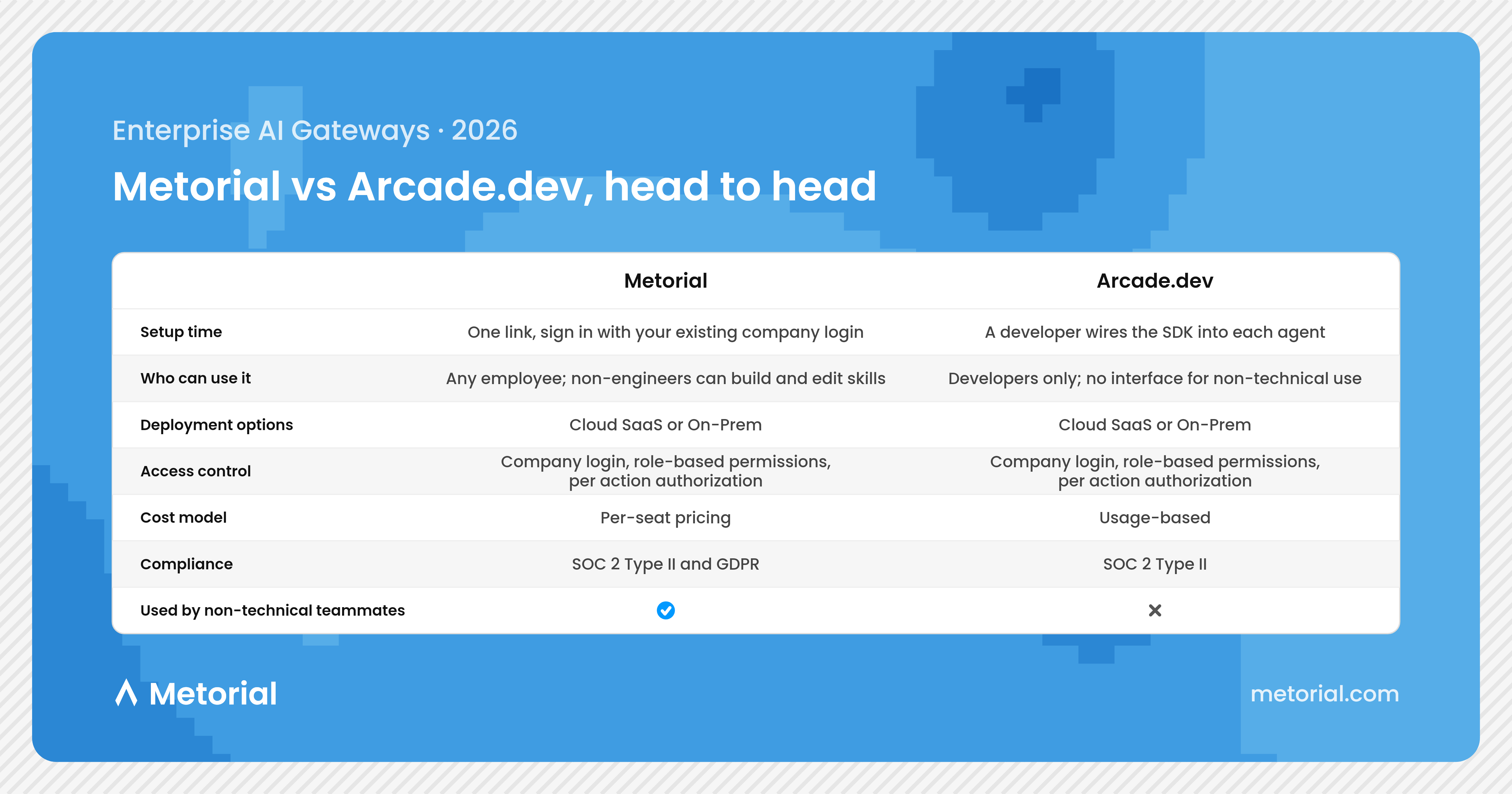
Comparison table
Both hold SOC 2 Type II, so that alone isn't what separates them. Depth of code-level authorization tooling versus breadth of who can use the system is.
The practical difference
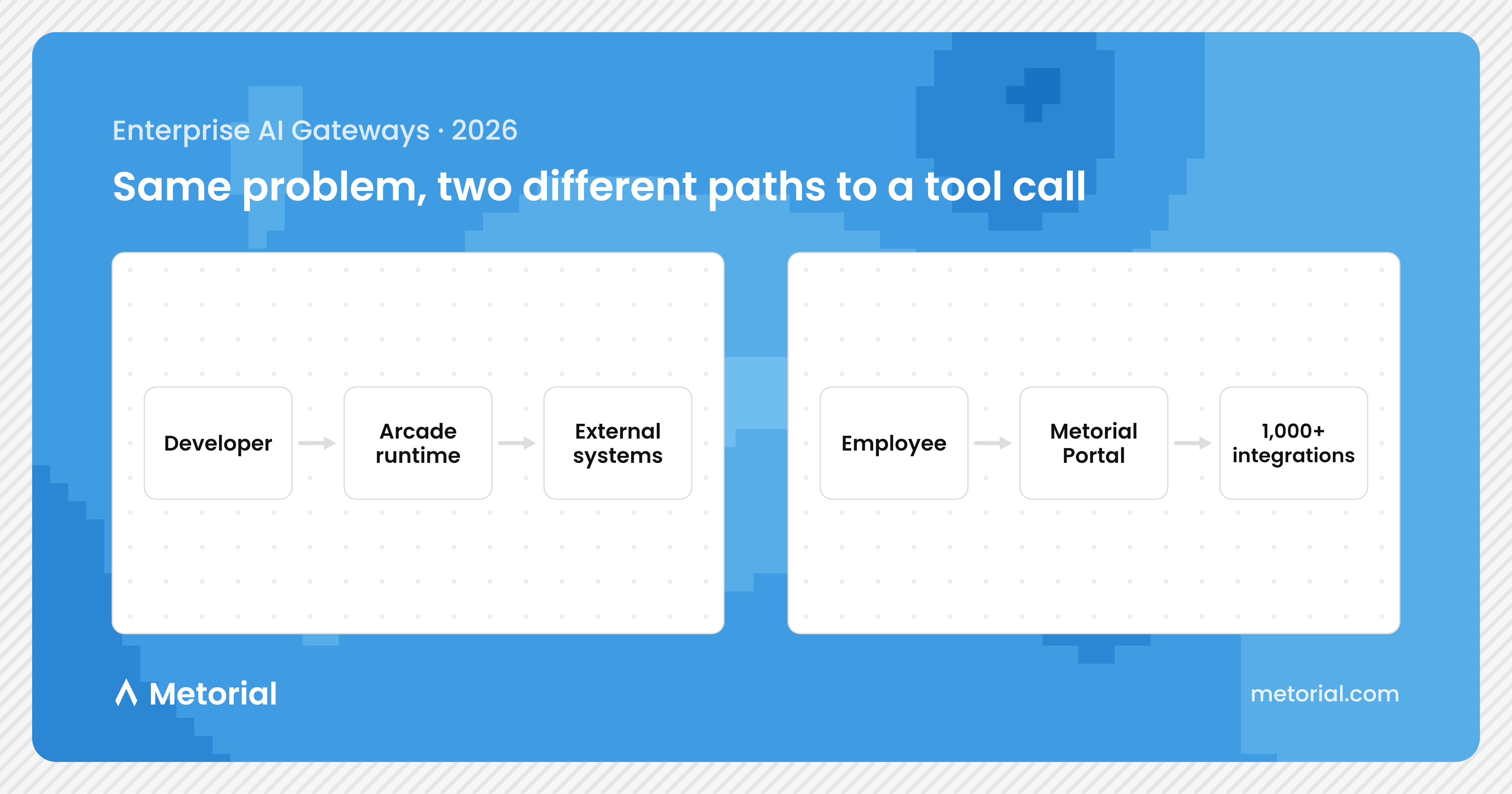
Arcade puts the integration work inside each application, done once per agent by a developer. Metorial puts it at the company level, in an entry point every employee already has.
That's not a different job. It's the same job plus one. Arcade decides what an already-built agent may do. Metorial decides that too, and decides how the next fifty people get an agent at all, which is the part that needs no engineer, and the part Arcade has no answer for.
Who should pick whom
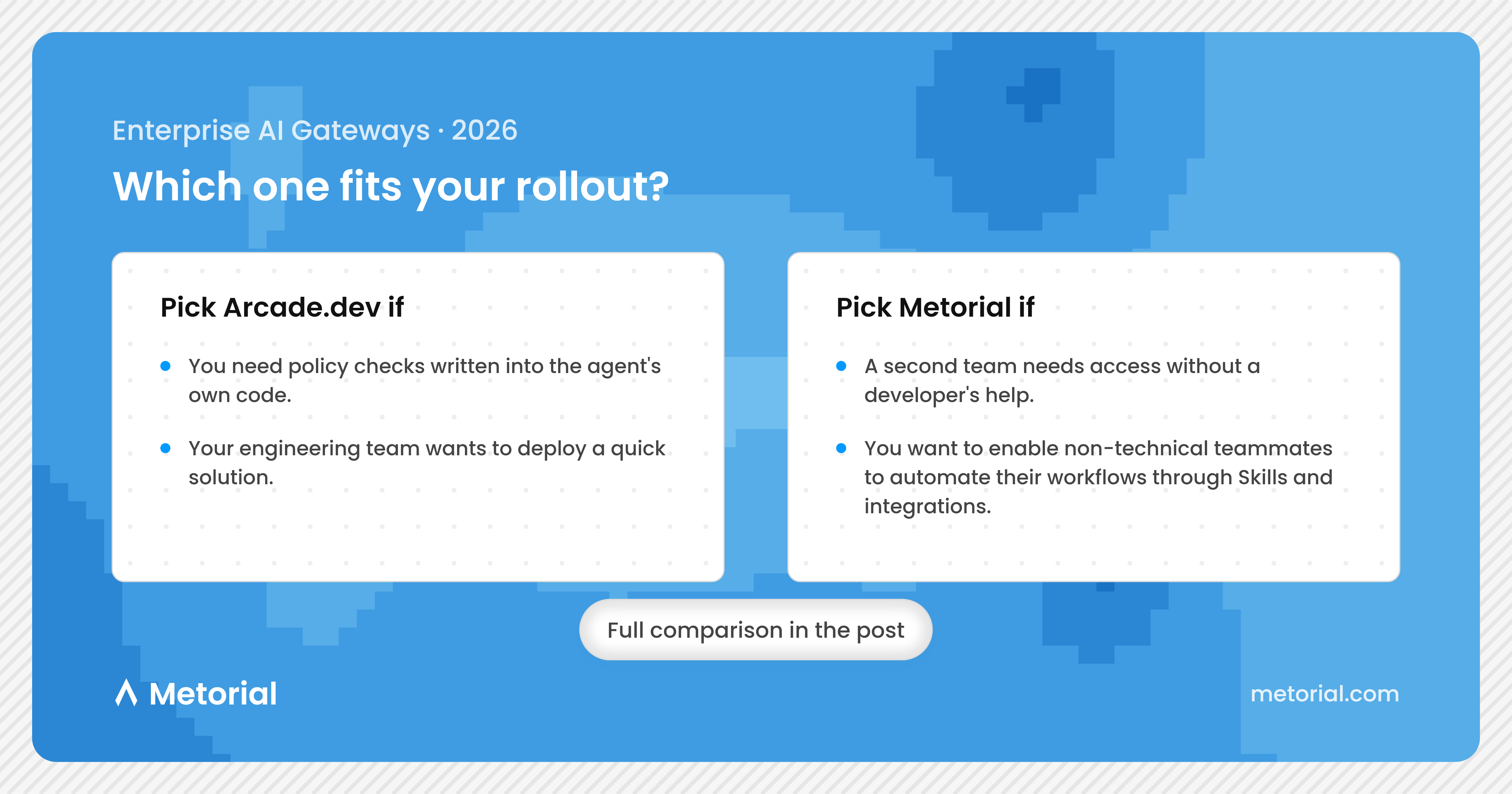
Pick Arcade.dev in one case: you need a policy check written into the agent's own code, mid-request, before the runtime is involved. Arcade's pre- and post-tool-call hooks do that. Metorial's policy layer runs at the point a tool is called, so a check that specific has to live in Arcade today.
Pick Metorial for everything else, and especially the moment a non-engineering team wants access. You get the same identity model, the same audit trail, and the same SDKs, plus a skill editor non-engineers can use, hosting for your own MCP servers, and a platform you can read the source of.
Want to see how it fits your own stack? Book a demo.
FAQ
What's a good alternative to Arcade.dev?
It depends on the problem you have. Arcade fits an engineering-only rollout that needs policy checks written into the agent's own code. Metorial covers the same identity and audit ground and adds skill sharing for non-engineers and hosting for your own MCP servers, which is what matters once a second team needs access. For a different head-to-head, see our Metorial vs Composio comparison.
Does Metorial have SDKs, or is it only a hosted gateway?
Both. Official SDKs for TypeScript, Python, adapters for OpenAI, Anthropic, AI SDK, PydanticAI, LangChain, and LangGraph, a CLI, and a platform where everything available in the dashboard is also available through the API.
Can I run my own MCP servers on Metorial?
Yes. Custom, remote, and Docker-based providers are hosted on Metorial in isolated enclaves and reached through the same connection and the same access policies as any managed integration.
Can Metorial and Arcade.dev be self-hosted?
Yes. Both deploy to your own cloud, a virtual private cloud, on-premises, or a fully air-gapped environment.
Does Arcade.dev support non-technical users?
No. It's built for developers, and its own documentation confirms there's no interface for someone outside engineering to set up or edit a tool.
How does pricing compare?
Arcade has a free tier, then moves to usage-based pricing, then custom enterprise pricing. Metorial is open source and free to self-host, with hosted plans for companies that don't want to run their own infrastructure.
What about Runlayer or Barndoor instead of Arcade?
Different jobs. Runlayer leads with third-party-audited security research. Barndoor leads with cutting token cost. Neither gives you Arcade's depth of code-level authorization or Metorial's non-technical skill sharing. The full five-way comparison covers all four alongside Metorial.
Sources
- Arcade.dev homepage (product claims, deployment, compliance, customers, spec authorship): arcade.dev
- Metorial for Developers (SDKs, CLI, API, callbacks): metorial.com/developers
- Metorial security page (SOC 2 Type II, GDPR): metorial.com/security
- Metorial GitHub repository: github.com/metorial/metorial